I Tried 9 Persimmon Soaps for “Aging Odor.” Here’s Why the One You Bought Probably Didn’t Work.
Most of what is sold as persimmon soap in the United States is fragrance and orange dye. The compound that actually binds the odor molecule is barely in it — and the label almost never tells you.
If you have already bought a persimmon soap and it did nothing, I want to start there — because that is where I started, and because it is the single most common message that lands in my inbox on this subject.
I am sixty-three. I did not come to this as an assignment — I came to it the way you did, at eleven at night, reading a thread I was not going to admit to anyone I had read.
And you read the same thing I read. That after about forty, skin begins producing a compound called 2-nonenal. That it is oily rather than watery, so ordinary soap slides straight past it. That in Japan they have used fermented persimmon tannin against it for centuries. It made sense. You ordered a bar.
And then, for a lot of women, nothing much happened.
The conclusion most people draw is that the persimmon thing is a myth. After going through nine of these bars, I do not think that is what is going on. The mechanism is not the problem. The dose is.
Of the nine bars I compared, only three list the actual tannin extract on the ingredient panel. One of those three is under $17 a bar and does not put you on a subscription. That is the one I ended up recommending to my sister.
“I had lunch with friends and afterwards one of them texted me that I’d had a slight odor when I sat down. I shower every day. Clean clothes, clean house. I spent the whole evening crying and telling myself I’m never leaving this house again.”
Denise, 58 — reader inbox, May 2026I get a version of that message most weeks, and I want to say the obvious thing about it before we go any further: this is not a hygiene failure and there is nothing to be ashamed of. Ordinary soap is built to lift water-soluble things off your skin. 2-Nonenal is oily. You are not doing it wrong — you are using a tool that physically cannot grip the thing you are trying to remove. Which is precisely why the ingredient matters so much, and why it is worth being fussy about which bar you buy.
The difference nobody puts on the front of the box
There are two completely different things being sold under the same words.
Kakishibu is fermented persimmon tannin. Unripe astringent persimmons are pressed and left to ferment for months. What comes out is a concentrated, tannin-rich liquid — and tannins are polyphenols, which is the relevant part: polyphenols carry multiple binding sites that latch onto aldehyde molecules like 2-nonenal and lift them away rather than rinsing past them.
Persimmon juice is pressed fruit. It is cheap, it is orange, and it photographs beautifully in a soap. It contains a trace of the same tannins, in roughly the way orange juice contains a trace of vitamin C tablet.
Both can legally be called persimmon soap. Only one of them is doing the job you bought it for.
Researchers have put the two materials side by side, and the numbers are not close. A concentrated persimmon tannin extract removed 97% of nonenal. Soaps made with diluted persimmon juice removed 33–35%. I did not run that test, and I am not presenting it as a test of any bar on this page — but that gap is the whole story of this category, and it explains almost every disappointed review I read. I did not run that test, and I am not presenting it as a test of any bar on this page — but that gap is the whole story of this category, and it explains almost every disappointed review I read.
A third of the odor removed is not nothing. It is also not enough for you to notice, which is exactly what women report: it helped a little, and by evening it was back.


The three things that decide whether a persimmon bar works
I scored every bar on the same three questions. They are not arbitrary — they are the three places this category actually fails.
Is it kakishibu, or is it juice?
Fermented tannin extract, or pressed fruit. This is the pass/fail gate and it removes most of the field on its own. A bar that cannot tell you which one it uses has told you which one it uses.
Can you read it on the label?
The INCI panel is the only claim a brand cannot quietly walk back. If the active is named there, you can verify it yourself in ten seconds. If it appears only in the marketing copy, you are trusting a headline.
What happens after you buy it?
This category has a subscription problem and a delivery problem, and I did not expect to be writing about either one when I started.
Several of these brands enrol you in auto-refill at checkout, and the largest single cluster of one-star reviews across the whole comparison is people trying to get out of one. Directly behind it is a second cluster: parcels that arrive weeks late, parcels that never arrive at all, cancellation emails nobody answers until after the thing has supposedly shipped, and charges appearing on a statement months after a single purchase.
A guarantee you have to fight for is not a guarantee. And a refund policy is worth nothing on an order that never showed up.
The Rankings
Kiyora Persimmon Soap
Fermented kakishibu · made in Japan · 100g bar · no subscription
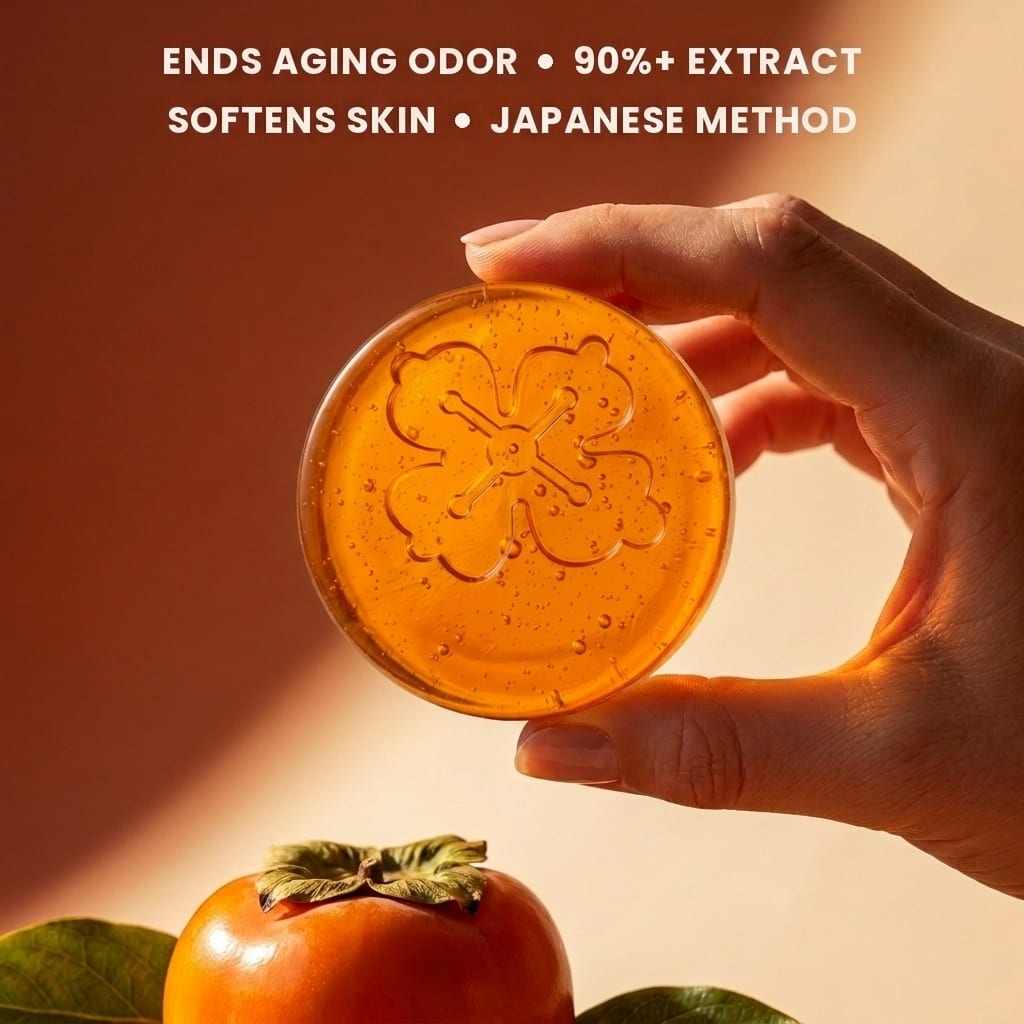
The short version: it is the strongest bar in the comparison and it has the cleanest terms attached to it, and those two things almost never travel together in this category. It is not the cheapest thing here on a single purchase. It is the one I would actually buy.
This is the one that changed my mind about the category. Kiyora is built on concentrated fermented kakishibu, at the highest extract concentration of anything in this comparison — and it is the only bar here that pairs that with a formula designed around the complaint everyone has about persimmon soap: that it dries you out.
It is also, by a distance, the smallest operation on this list, and I have come round to thinking that is part of why it is any good. Kiyora was started by a Japanese founder who grew up with kakishibu in the house and could not find the same thing on an American shelf.

That gap is real, and it is worth understanding before you buy anything in this category. In Japan kakishibu is not a discovery or a wellness trend — it is a slightly old-fashioned thing that has been in the house for generations, used on fabric, paper and skin, and nobody there needs it explained. In the United States the word arrived first and the material arrived second, if at all. It became a marketing term attached to whatever was cheap and orange. Kiyora reads like somebody trying to reproduce one specific bar they remember, rather than a brand trying to enter a trending category.
Four ingredients do the work. Kakishibu to bind the odor. Shea butter to calm mature skin. Olive fruit oil and glycerin to keep the bar from stripping. Persimmon tannin is astringent by nature — that is why it works, and it is also why the cheap bars leave you itching. Three of the four ingredients here exist to solve that.
It is a full 100g bar rather than the 60–70g bars that dominate the marketplace listings, which is most of the reason the per-wash cost lands where it does despite a higher sticker price.
And then the part that ended up deciding it. They have the clearest buying terms of anyone in this comparison, and it is not close. No auto-refill. No subscription. No cancellation flow, no gift ladder, no minimum order designed to keep you shipping. You buy the number of bars you want, they arrive quickly, and that is the end of the transaction. After reading several hundred one-star reviews that were all about exactly this, I do not consider that a small feature.
| Active | Fermented kakishibu, 90%+ tannin extract (lot-tested) |
| Bar weight | ~100g |
| Origin | Japan |
| Price | $24.95 · $16.63/bar (buy 2 get 1) · $14.97/bar (buy 3 get 2) |
| Subscription | None |
| Delivery | Ships promptly from a single store; no marketplace resellers |
| Guarantee | 100% back, 60 days, no return shipping |
What it gets right
- Fermented kakishibu, named on the ingredient panel
- The highest extract concentration of any bar in this comparison
- Full-size 100g bar, not a 60g marketplace bar
- Three of four ingredients exist to stop the dryness that ruins cheap persimmon soap
- No subscription, no auto-refill, no cancellation flow
- Money back within 60 days, no forms and no return shipping
Falls short
- Newest brand here — no long review history to read through yet
- Not the cheapest option on a single bar; the arithmetic works when you buy the bundles
- Batch-limited to one harvest a year, so it does go out of stock
100% money-back guarantee · 60 days · no subscription · no return shipping
The rest of the field
Mirai Clinical Deodorizing Soap
The brand that built this category in the US
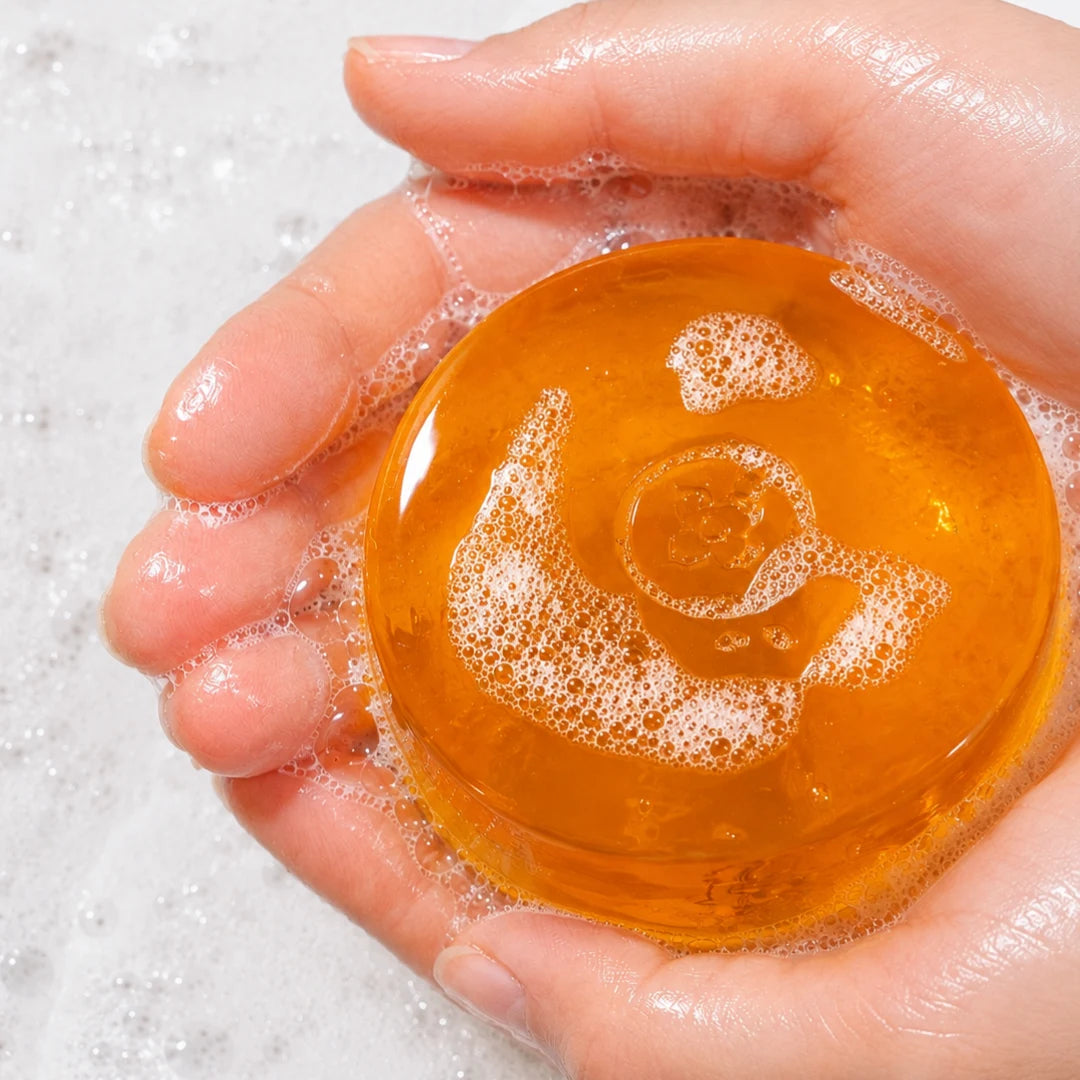
Credit where it is due: the soap is real. Mirai use a genuinely concentrated persimmon extract rather than juice, there is green tea extract in there too, and they were on Shark Tank. If this list were scored on the bar alone, Mirai and Kiyora would be separated by very little.
It is not scored on the bar alone, and this is where it comes apart. Their own public reviews carry a recurring theme, and it is not a flattering one — orders nobody remembers placing, charges arriving weeks after a single purchase, parcels that do not turn up, and refunds that become a negotiation rather than a refund. One reviewer describes being billed $47 for a second order they never made, with no reply to either the email or the phone message. Another describes a two-week back-and-forth in which the amount they were being offered back got smaller every time it was discussed.
And there is no meaningful guarantee sitting behind any of that. What is on offer is an ordinary returns window, which is exactly the thing that is no use to you when the problem is that the order never arrived in the first place.
| Active | Concentrated persimmon extract + green tea |
| Price | $19.97 direct · $17.95 on Amazon |
| Rating | 4.3 ★ across 2,157 marketplace ratings |
| Subscription | Subscribe & save with a multi-delivery gift ladder |
| Guarantee | Standard returns window only |
What it gets right
- Genuinely concentrated extract, not juice
- Green tea extract adds a second polyphenol
- Widely available, easy to find, easy to reorder
Falls short
- Repeated reports of charges customers say they did not authorise
- Orders that arrive very late or do not arrive at all
- Refund disputes described as drawn-out and negotiated down
- Subscription structure built to keep you enrolled
- No real guarantee — a standard returns window and nothing more
Persea Persimmon Soap
The “unripe fruit only” pitch

Persea makes the right argument. Their pitch is that only the unripe astringent fruit carries the tannins that matter, which is correct and is more than most of this list will tell you. The offer looks clean on paper too — buy two get one, buy three get three, sixty days, free returns, no subscription in the flow.
What I could not find anywhere was verification. No published concentration. No certificate of analysis. No third-party testing. Nothing that turns the argument into a number. When a brand tells you the mechanism this precisely and then goes quiet at the one point where a figure would settle it, that silence is information.
Nor is there much of a record to fall back on. The brand is new enough that there is almost no independent account of anyone using it, and the little that does exist is thin — a handful of comments, and complaints about slow dispatch and unanswered messages that I could not weigh properly because there simply is not enough of it. The argument is right. Everything underneath the argument is a promise.
What it gets right
- Correctly identifies unripe fruit as the source of the active
- Bundle offer looks clean — 60 days, free returns
- No subscription
Falls short
- No published concentration or certificate of analysis
- No third-party testing referenced anywhere
- Almost no independent review history to check
- The little feedback that exists mentions slow dispatch and unanswered messages
- A generous returns policy is only as good as the company honouring it, and there is no track record here either way
“I finally caved and bought the Japanese persimmon soap that gets rid of old people smell — and it works. But I bought the cheap one first and it did nothing except turn my washcloth orange.”
Barbara, 61 — reader inbox, July 2026Kaori Persimmon Soap
Heavily advertised, aggressively bundled
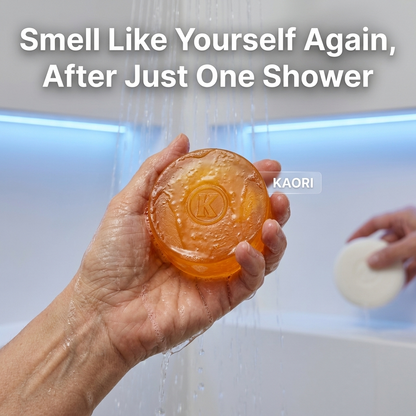
You have almost certainly seen Kaori’s advertising, because there is a great deal of it — long first-person stories about a woman being humiliated by a relative and then vindicated at a wedding. The soap underneath appears to be a genuine persimmon bar, and the bundle pricing gets aggressive fast: $19.95 for one, $8.99 a bar if you buy ten.
Two things kept it out of the top three. There is no published concentration anywhere I could find, which after everything above is the number that matters most. And the fulfilment record is poor — the public reviews that exist are dominated by orders that took weeks or never arrived, with cancellation requests going unanswered until after the item had supposedly shipped.
What it gets right
- Appears to be genuine persimmon, not fragrance
- Steep bundle pricing if you buy deep
- 60-day money-back policy on paper
Falls short
- No published tannin concentration
- Delivery and cancellation complaints dominate the public record
- Subscribe & save enrolment at checkout
- Ten-bar tiers push you far past what you need to test it
Still reading? The short version is on the label.
See the #1 Kiyora Bar →Fermented kakishibu · 100g · no subscription
Swarva Deodorizing Persimmon Soap
The subscription complaint machine
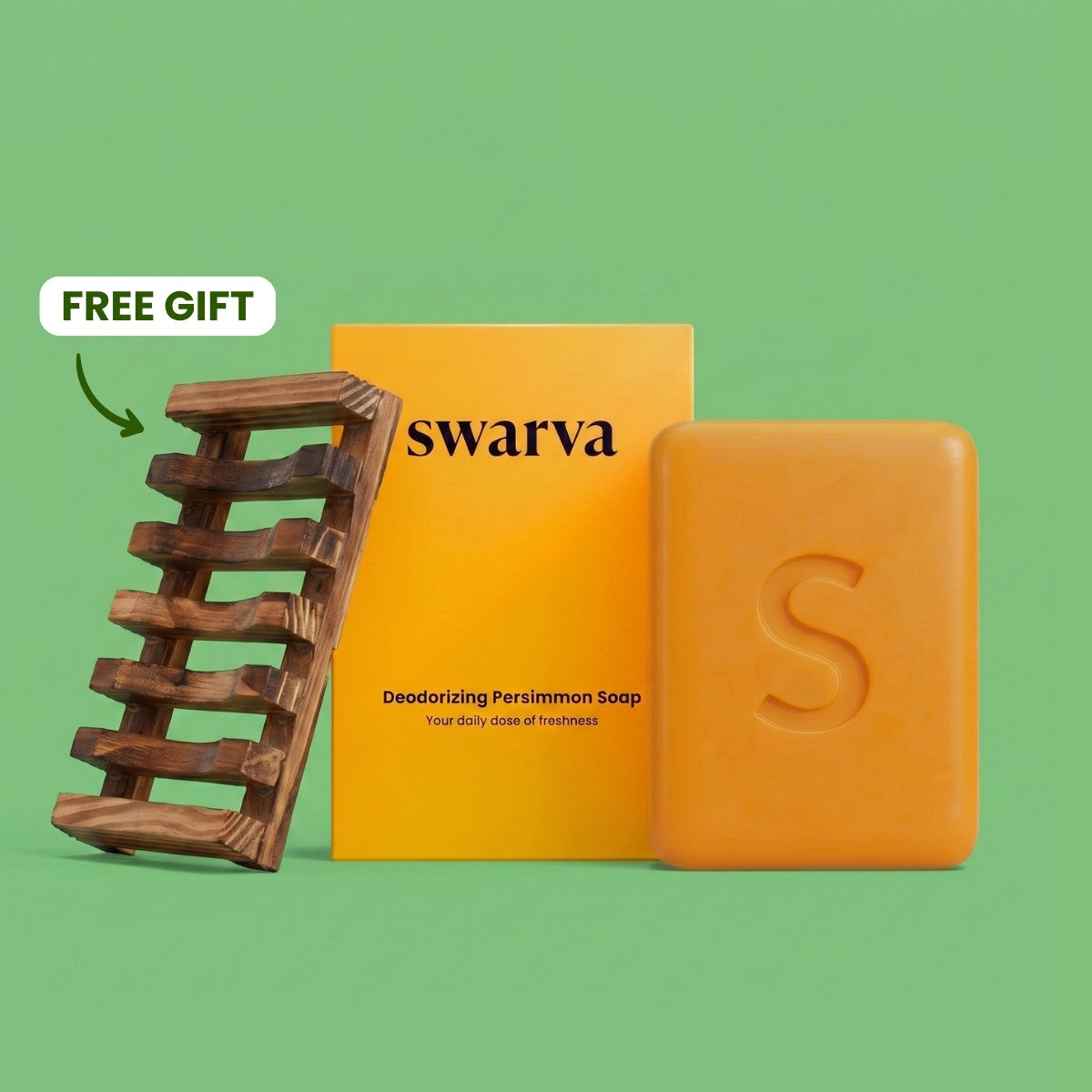
Swarva has the most reviews of any direct-to-consumer brand here — over thirteen hundred — and a respectable average. They claim a concentrated extract rather than a trace, they explain the chemistry accurately, and they throw in a bamboo dish at the top tier.
And then there is the single largest cluster of one-star reviews in this entire comparison, by a wide margin, and every one of them is about the same thing. “The subscription notice was a complete surprise.” “I tried cancelling on the website — I just received notice that my new subscription is being processed.” “I only ordered this once, a few months ago, and it keeps taking money out of my account.” It is not a handful of confused customers. It is the defining pattern of their public record.
Running underneath it is a second complaint about orders that arrive very late or not at all, and about support that goes quiet exactly when you need it to answer. Which is the worst possible combination: easy to be charged, hard to be delivered to, hard to get anyone on the other end.
What it gets right
- Largest review base of the DTC brands here
- Claims a concentrated extract, and explains the mechanism accurately
- Free bamboo dish at the six-bar tier
Falls short
- Auto-renewal enrolment that reviewers repeatedly say they never chose
- Cancellation reported as not working
- Refunds described as partial rather than full
- Site traffic falling sharply month over month
CURO Deodorizing Soap with Persimmon
Arrived this summer
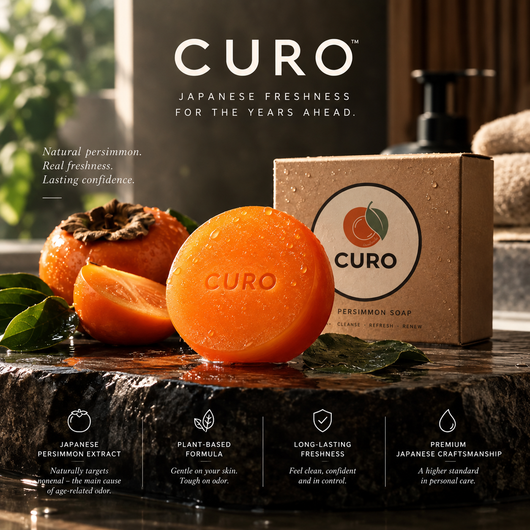
CURO’s advertising leans on the 2001 Japanese research and makes the correct point that most soaps carry only a whisper of extract. I agree with them. I simply cannot tell you whether their own bar is the exception, because there is no published concentration, no certificate, no review history and almost no trading record — the brand has been visible for a matter of weeks.
What it gets right
- Names the real mechanism accurately
- Explicitly calls out under-dosed competitors
Falls short
- No concentration published
- No certificate, no third-party testing
- No review history at all
- Too new to have a fulfilment record
yoniagood 3-Pack Persimmon Soap
$9.99 for three · marketplace bestseller
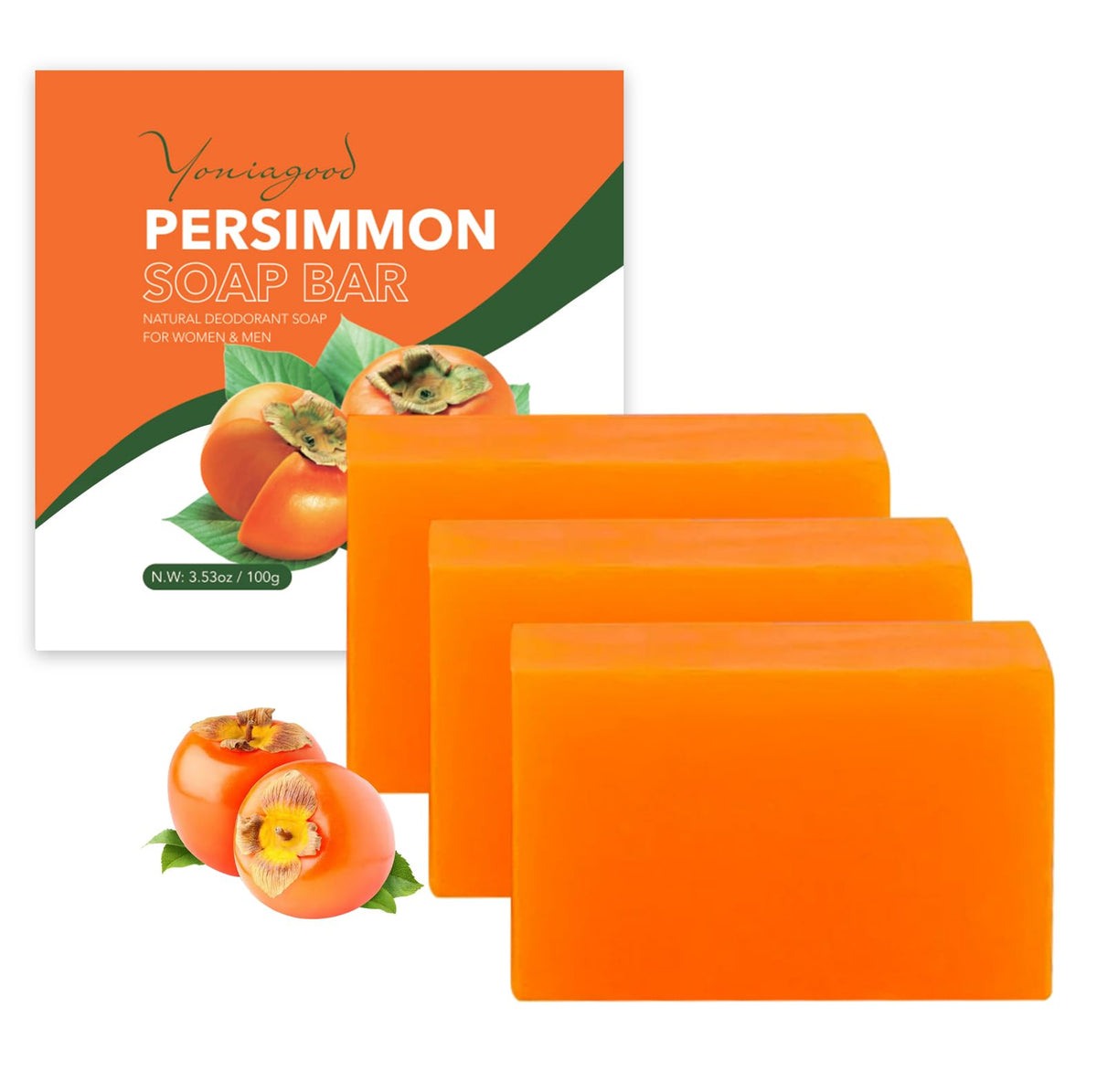
This is the bar most people mean when they say persimmon soap did not work for them. It sells in enormous volume, it has a good star average, and its own listing tells you the problem in its own words: the formula “primarily consists of fresh persimmon extract.” Fresh, not fermented. Juice, not kakishibu.
The one-star reviews then read exactly as you would expect from a dyed juice bar: orange residue on everything it touches, bleeding colour onto dishes and towels, scent that either vanishes in minutes or is overpowering, and a bar that is half gone after two washes.
What it gets right
- Genuinely cheap
- Pleasant enough as an ordinary soap
- Easy to get, ships fast
Falls short
- Fresh fruit extract, not fermented tannin
- Orange dye bleeds onto dishes, cloths and towels
- Bar dissolves quickly for its size
- Reviews split between “no scent” and “nauseating scent”
GPP 3-Pack Persimmon Soap
$8.99 for three · 3.53oz bars
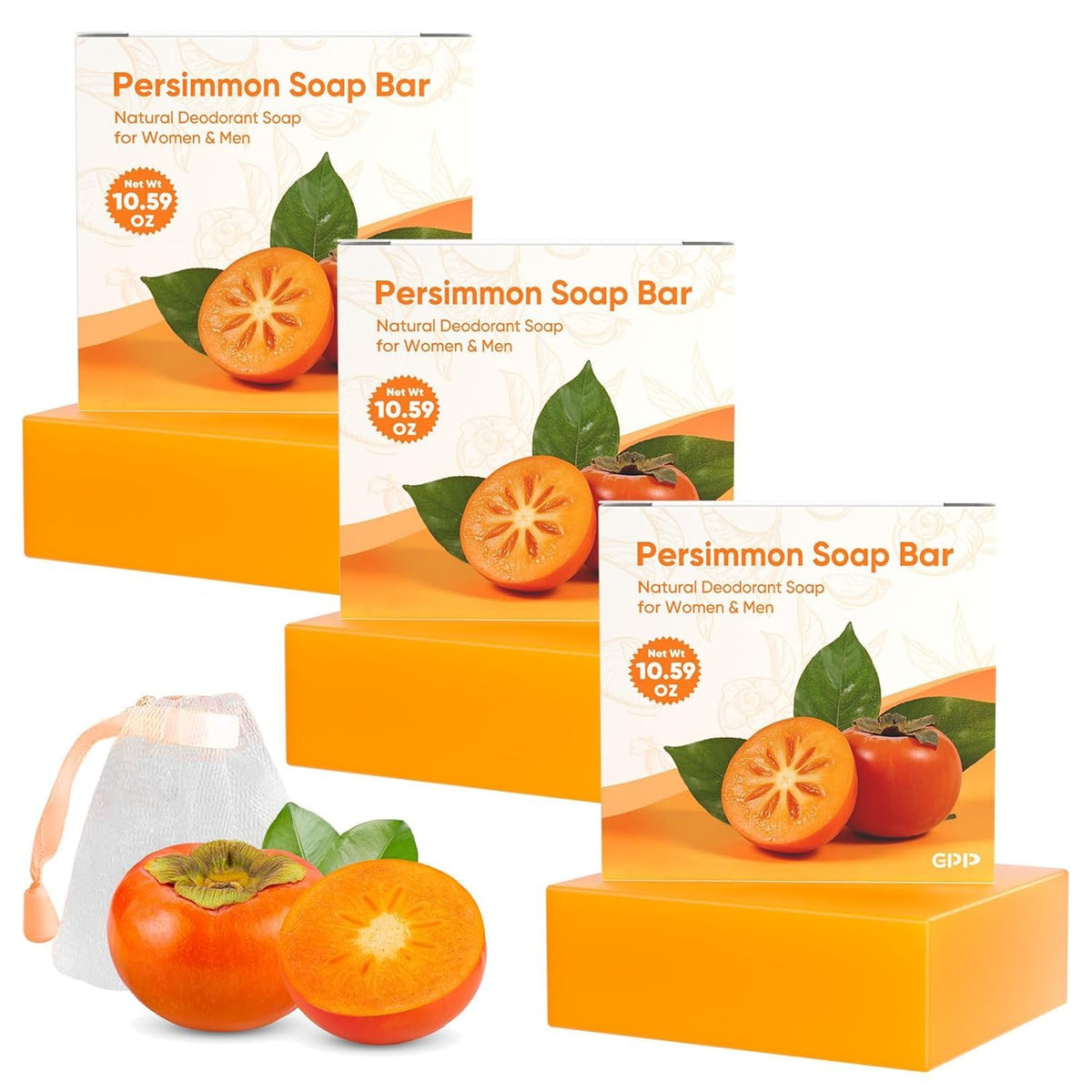
Same category, same problem, slightly cheaper. The listing markets itself to “anyone over 40 years of age” and calls itself an antioxidant soap, which is a claim about the fruit rather than a claim about the dose. There is no concentration figure and no mention of fermentation anywhere in the listing.
What it gets right
- The cheapest per bar in this comparison
- Full 3.53oz bar weight, which not all budget bars manage
Falls short
- No fermentation, no concentration, no certificate
- Marketed on the fruit, not the active
- Same dye and dryness complaints as the rest of the budget shelf
Persimmon-scented bars
The ones that just smell like fruit
Worth naming because they are everywhere and they are the reason this whole category has a credibility problem. A bar can carry persimmon in the name and on the wrapper while the persimmon exists only in the fragrance oil. There is no active. There is no mechanism. There is a nice smell, and it is gone by the time you are dry.
If the panel says fragrance or parfum where you expected to see an extract, that is what you have.
Side-by-side
| Kiyora | Mirai | Persea | Kaori | Swarva | CURO | yoniagood | GPP | |
|---|---|---|---|---|---|---|---|---|
| Fermented kakishibu | Yes | Yes | Claimed | Unstated | Claimed | Unstated | No | No |
| Concentration published | Yes | Yes | No | No | No | No | No | No |
| Active named on panel | Yes | Yes | Partial | Partial | Partial | No | No | No |
| Made in Japan | Yes | Yes | Unstated | Unstated | Unstated | Unstated | No | No |
| Full-size bar (~100g) | Yes | Yes | — | — | — | — | Small | Yes |
| No subscription | Yes | No | Yes | No | No | — | Yes | Yes |
| Guarantee | 100% / 60d | Returns only | 60d | 60d | 60d | — | Marketplace | Marketplace |
| After you buy | Clean | Billing + delivery | Unproven | Delivery | Billing | — | Marketplace | Marketplace |
| Price per bar (best tier) | $14.97 | $17.95 | $12.48 | $8.99 | $10.00 | — | $3.33 | $3.00 |
Scroll the table sideways to see every brand →
Three things this category does not volunteer
“Persimmon soap” is not a formulation, it is a marketing word
There is no standard behind it. A bar with 90%+ concentrated fermented tannin and a bar with a drop of fruit juice and orange dye can print the same two words in the same size type. Nothing in the labelling rules stops it. This is why the reviews for this category are so violently split — people are reviewing completely different products under one name.
If the smell came back by evening, the product did not stop working
2-Nonenal is produced continuously by the oxidation of skin oils. Washing clears what has accumulated; it does not switch off production. Daily use is the protocol the mechanism requires, not a sign the bar has failed — and any brand that sells you a bar as a one-time fix is setting you up to be disappointed.
Judge the bar by whether light goes through it, not by its colour
Fermented kakishibu is almost black in the vat. What it looks like in a finished bar depends entirely on the base it goes into. In a clear glycerin base it reads as translucent amber, like honey held up to a lamp — you can usually see small bubbles inside it. Stirred into a standard opaque soap base with colourant, you get a flat, solid, uniform orange that light stops dead at. Same two words on the wrapper. So do not judge the shade. Hold it up to a window and see whether anything gets through.
What I would check before buying any of them
- Read the panel, not the front. Look for kakishibu or fermented persimmon tannin. “Persimmon fruit extract” is juice. “Fragrance” is neither.
- Ask for the number. Any brand with a real concentration will tell you it immediately. The ones that change the subject have answered you.
- Check the bar weight. A $19 bar at 60g is more expensive per wash than a $25 bar at 100g, and marketplace listings are quiet about this on purpose.
- Read the checkout page, not the sales page. This is where the subscription lives.
- Give it two weeks and ask someone else. You cannot audit your own smell — that is the entire nature of this problem. The person you live with can.
“I don’t think I have the smell yet, but I remember it from my grandmother’s house. I started using it as a precaution. My daughter says I smell wonderful, and I have total peace of mind now.”
Janet, 67 — reader inbox, June 2026After nine bars, here is where I would spend the money
If you have already tried persimmon soap and it did nothing for you, I would not conclude the idea is nonsense. I would look at what you bought. The odds are very good that it was fresh fruit extract in a dyed bar, and that it removed roughly a third of the problem — which is precisely the amount you would never notice.
Kiyora is the only bar here that clears all three gates: fermented kakishibu at the highest extract concentration in this comparison, named where you can read it, with nothing attached to the checkout and a full sixty days to change your mind. It is also the only one where the rest of the formula is built around the reason cheap persimmon soap makes people itch.
Check Kiyora Price & Availability →100% money-back guarantee · 60 days · no subscription · no return shipping